Campus Network Security Design
Segmentation, access control, and detection for a three-floor academic building
A full network security design for an academic building at UMES: offices, conference rooms, classrooms, teaching labs, and a server room across three floors. Six VLANs partition the network by function, an ACL matrix governs what each one may reach, and a SIEM plan turns the resulting traffic into alerts mapped to MITRE ATT&CK techniques. This is a design study rather than a deployment. What follows are the decisions and the reasoning behind them.
Results
Diagrams
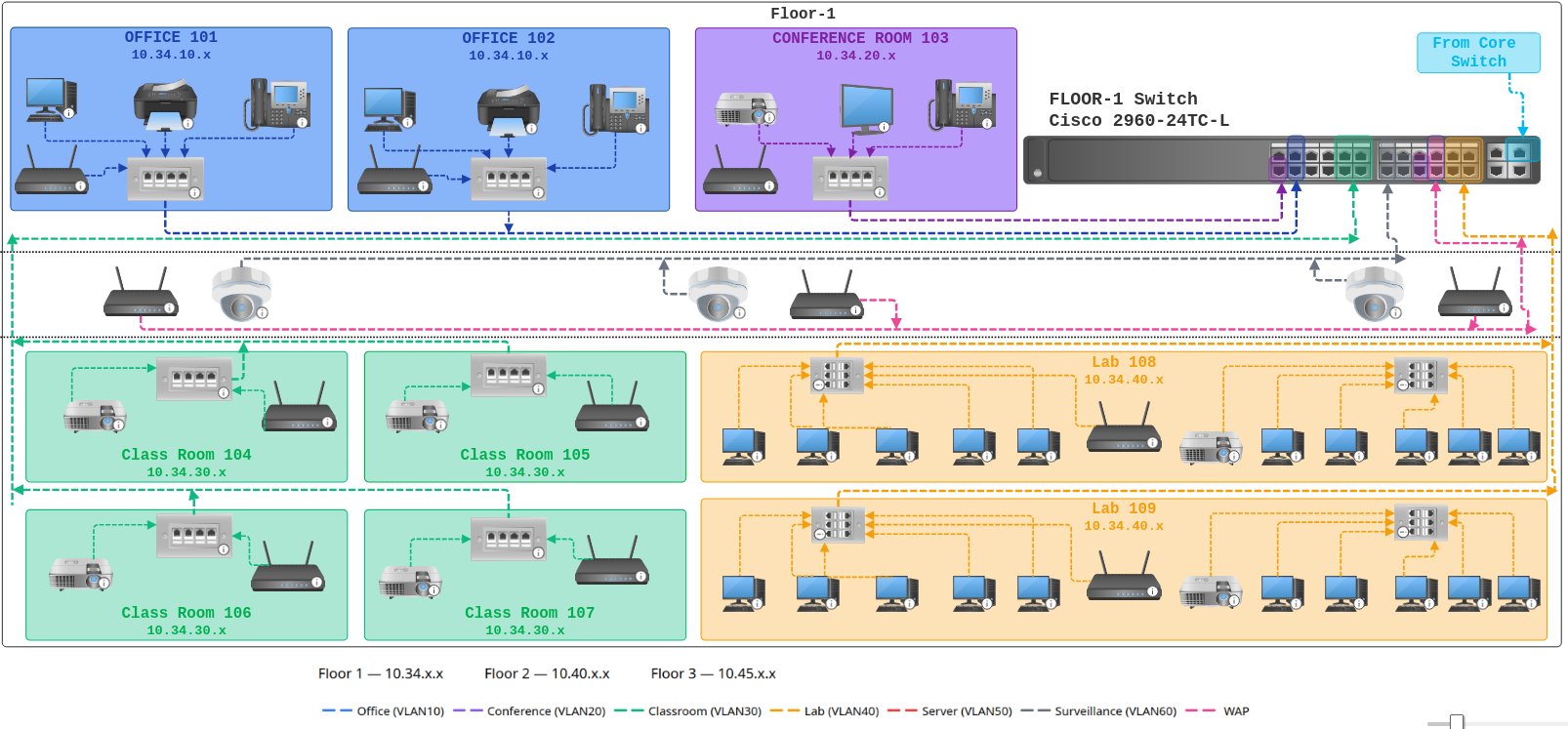
Fig1Floor 1. Offices, conference room, four classrooms, and two teaching labs feeding a Cisco 2960-24TC-L, with the hallway access points and dome cameras on the surveillance VLAN. Colors track the VLAN legend along the bottom. Open for full size. 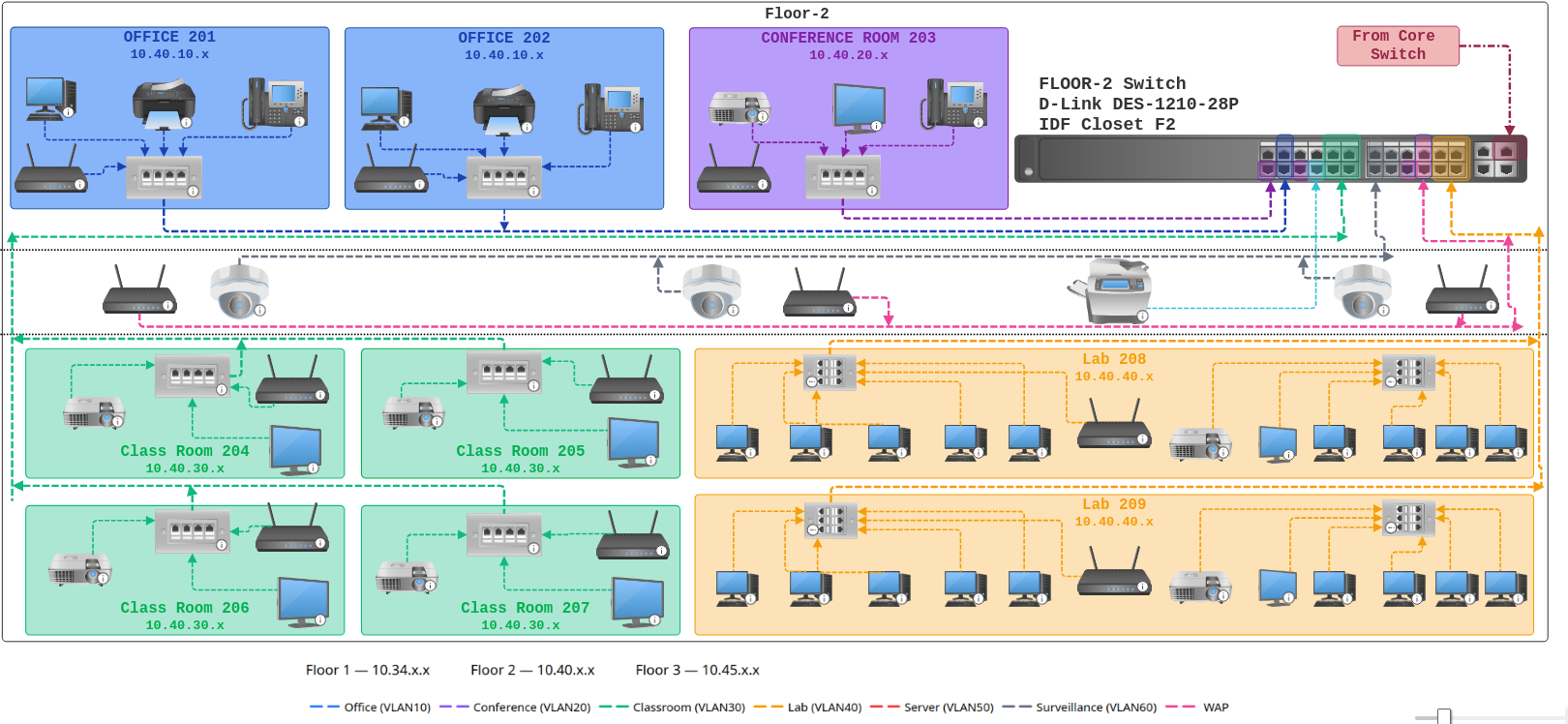
Fig2Floor 2. The same functional zones on a PoE switch, which powers the access points and VoIP phones directly. A hallway printer joins the surveillance segment on this floor. Open for full size. 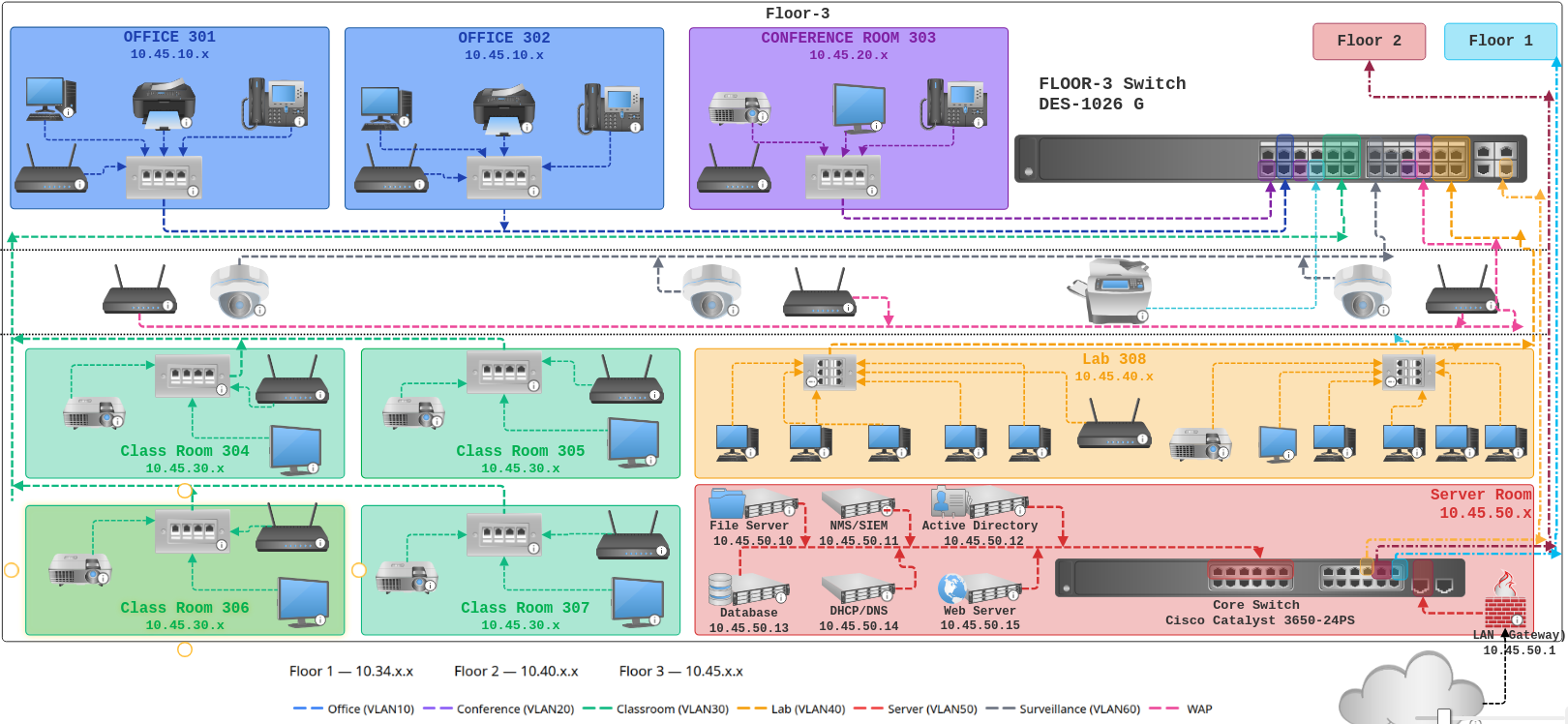
Fig3Floor 3, carrying the server room. Six servers sit on the server VLAN behind the Cisco Catalyst 3650-24PS, which is the sole inter-VLAN routing point for the building. Uplinks to the lower floors run top right. Open for full size.
01The brief
One building, three floors, and five kinds of space that have nothing in common from a security point of view. Staff offices hold managed machines. Classrooms carry whatever students bring through the door. Teaching labs need licensed software pinned to known addresses. Hallway cameras should never touch the internet at all.
Putting them on one flat network means the least trusted device in the building shares a broadcast domain with Active Directory. The design starts from the assumption that a student laptop will eventually be hostile, and works backward from there.
02Segmentation and access
Six VLANs split the building by function rather than by floor, so a classroom on the third floor is governed by the same policy as one on the first. The addressing scheme carries that meaning: the second octet identifies the floor and the third identifies the VLAN, which makes a subnet readable at a glance and a misconfiguration obvious.
Extended ACLs on the core switch enforce the policy matrix. Student and lab VLANs are blocked from the server and staff VLANs outright, cameras are reachable only by the SIEM, and the native VLAN is parked on an unused ID so double-tagged frames cannot hop between segments.
Access control sits underneath all of it. Every wired port runs 802.1X against Active Directory, with certificate authentication for staff and passwords for students. Unauthenticated devices land in a quarantine VLAN behind a remediation page. DHCP snooping, dynamic ARP inspection, and IP source guard close off rogue servers, ARP poisoning, and address spoofing at the port.
03Cryptography and monitoring
Cipher choices follow the hardware rather than a single house standard. Staff wireless uses WPA3-Enterprise with AES-256-GCMP. Management sessions to the switches run TLS 1.3 with ChaCha20-Poly1305, which was chosen because the hallway cameras have no hardware AES acceleration and a software stream cipher keeps that traffic cheap. Wireless authentication uses ECDSA on P-384 for RSA-7680 equivalent strength at a fraction of the handshake cost.
Monitoring centers on one server running Zabbix for metrics and Wazuh with Elastic for logs, fed by SNMPv3 polling, syslog, and NetFlow records from the core. Ten correlation rules turn that into alerts with defined thresholds and named responses, covering credential stuffing, lateral movement, and data exfiltration, each tied to the ATT&CK technique it detects.